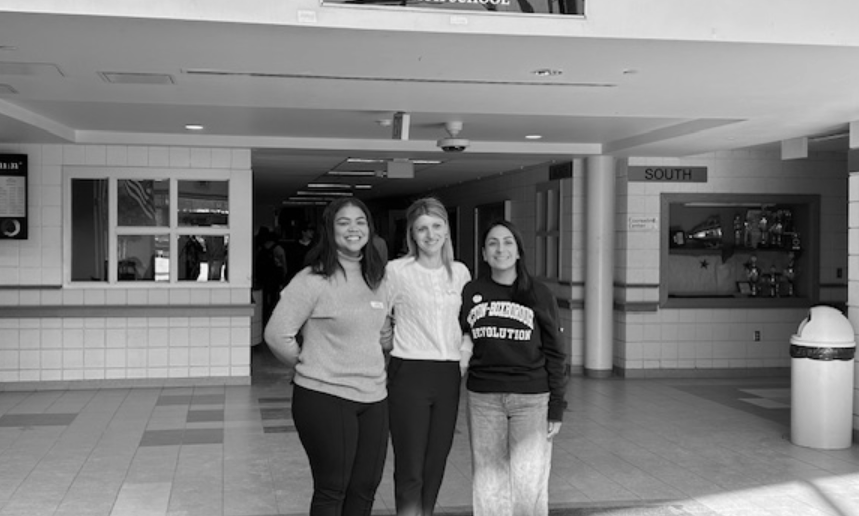
Every student—regardless of their ethnicity, ability, or geographical location— deserves the invaluable opportunity to learn and grow. We firmly believe that education should be accessible to everyone, a principle embodied by our dedicated Fulbright scholars, Lali Terterashvili, Ivannia Rivera, and Louise Torres. Each of these remarkable individuals bring a unique perspective to the table, drawing inspiration from their diverse backgrounds in their respective home countries—Costa Rica, Georgia, and Nicaragua. The scholars’ multitude of cultures and experiences has helped broaden our perspectives on learning. Through meaningful conversations with the scholars, we were able to dive deeper into how education can be implemented across various cultural contexts. Our guests made it clear that their visit to America held a distinct purpose.
Ivannia described the day she learned she was selected for the Fulbright program as profoundly emotional; she felt immense pride in being given this opportunity. Ivannia teaches in an indigenous community in Costa Rica that lacks technology, electricity, and clean water. She views her greatest challenge as pushing the boundaries of problemsolving and navigating educational limitations within her unique community. For Ivannia, the most surprising aspect of the American education system was the availability of resources. Reflecting on her Fulbright experience, Ivannia credited it with broadening her perspective on education. During her time in America, she discovered new communication skills that will help her better aid her students back home in Costa Rica. She has learned about a “new reality” through her time in America and aims to apply every positive aspect of American education in her future teaching.
Despite being thousands of miles apart, Lali’s teaching journey closely mirrored Ivannia’s. She reminisced about her early teaching experiences near the Russian border; she emphasized that instead of attending school, students were encouraged to learn at home. Lali faced obstacles in motivating both parents and children to engage in education. When discussing how Georgian schools operate, she noted several differences between the educational systems in America and Georgia. She found our school’s schedule to be more flexible and diverse, which she believed enhanced student learning compared to Georgia’s more rigid framework. Upon returning to Georgia, Lali’s most significant change in her teaching approach will be her attitude. She observed that teachers in America seemed, in a sense, “friendlier” than she was accustomed to. She regarded this style of teacherstudent interaction as surprisingly effective. In discussing the differences in Georgian education, Lali also expressed pride in her culture, highlighting that her people’s determination for independence persists despite the global challenges they face.
While learning about Costa Rica and Georgia, we were also fortunate to explore the land of lakes and volcanoes: Nicaragua. Louise began by sharing her motivation for teaching and participating in the program. Her primary interest in pursuing teaching centered on exploring special education and language-learning abilities in that region. The aspect of American education that shocked Louise the most was the disparity between schools. The economic status of a school’s region often affects the quality of education in our country. In Nicaragua, Louise noted that the geographical disparity in education was similar. Not every school in Nicaragua has the same facilities, and the variation in educational quality correlates with wealth. However, a more pressing issue in her home country is the lack of governmental support. Louise emphasized the insufficiency of funding for education in her home nation, stating that the consistent funding of the American education system is what allows students here to thrive.
Overall, the most important takeaway from our conversation with the scholars was that every educational experience is different. Each teacher encountered distinct challenges in their home countries, and at AB, we face our own challenges every day. Education is not guaranteed, and we are fortunate to have the resources and capability to provide it to everyone in our community. The experiences of Ivannia, Lali, and Louise in their homelands and America show that there is always room for both students and teachers to grow and learn. Lastly, it requires immense courage to travel to a new country and participate in the Fulbright program, so be sure to appreciate our three scholars and their efforts!