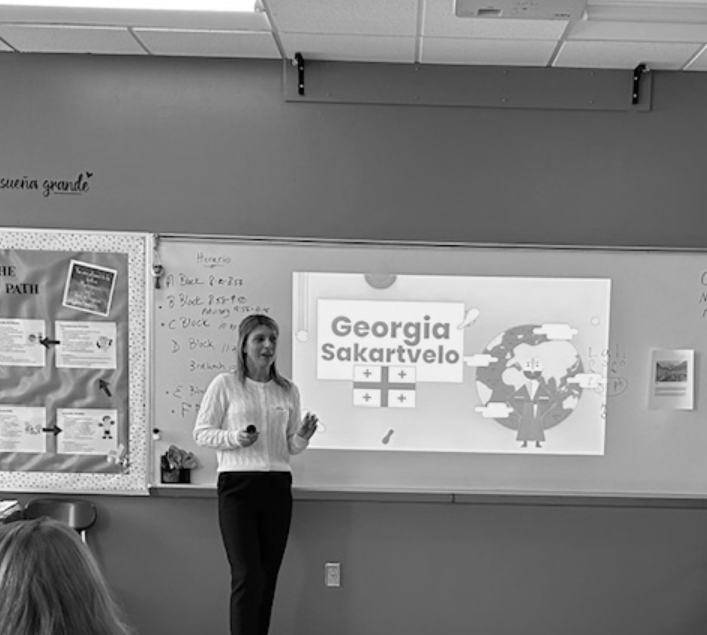
Over the past couple of years, various faculty members, from Ms. Berg to Señora Savukoski, as well as other integral members of our community, such as Senator Jamie Eldridge. For this issue, we decided to branch out and offer our readers something different. Instead of focusing on our school, we are proud to introduce Lali Terterashvili, a Fulbright scholar from Georgia.
The Fulbright Program was established to promote education through cultural exchange for scholars worldwide. Currently, forty-nine countries participate in the program. Founded by U.S. Senator J. William Fulbright, it is recognized as one of the most prestigious scholarship programs, offering grants to educators to study, research, teach, or showcase their talents abroad. Each year, 8,000 grants are awarded, and over time, more than 350,000 individuals have taken part in the program. Among them, 62 scholars have won a Nobel Peace Prize, underscoring its prestige.
While many at AB know Lali simply as a Fulbright scholar from Georgia, she shared a much deeper perspective on her identity during her visit. Born in an area of Sakartvelo (Georgia) occupied by Russia, she grew up under circumstances unimaginable to most of us, with guns and bombs as part of her reality. Despite these hardships, she takes immense pride in her country and community—a quality our readers can appreciate. Throughout her visit, she frequently spoke about the beauty of Sakartvelo, fully embodying the concept of national pride.
As Lali explained, although Sakartvelo is a relatively small country, it has a rich history and a vibrant culture. The first human remains found outside of Africa were discovered in Dmanisi, a region of Sakartvelo, and its society has been evolving ever since. The Georgian language reflects this growth, with each letter in its script symbolizing “beauty and grace.” Despite its ancient roots, Sakartvelo’s modern culture is equally fascinating. Lali passionately shared that award-winning films, such as Mandarinebi, continue to be produced, and funk music remains popular despite the country’s small population. However, these cultural achievements do not fully capture the extent of Sakartvelo’s talent. The Russian occupation has not only hindered the country’s physical and cultural development but it has also actively silenced its people. Lali has worked with organizations to raise awareness about these injustices, and upon arriving in America, she was struck by the level of freedom we often take for granted. Lali’s visit reminded us that cultural exchange is not just about sharing knowledge, but about fostering understanding and empathy across borders.
As writers, we rely on the freedoms granted to us to create articles like this. However, in doing so, we are reminded that not everyone enjoys the same rights. This privilege can sometimes lead us to believe that, as Americans, we have a superior culture, when in reality, we have much to learn and improve upon. Opportunities differ across the world, and Lali noticed many contrasts between our community and Sakartvelo.
When asked what a typical school lunch looks like in Sakartvelo, she explained that students have limited, paid options. She pointed out that our school’s students should be grateful for the resources provided—even the smallest ones. Her stories of resilience and community spirit highlight the importance of recognizing our shared humanity, regardless of geographical differences.
Additionally, she observed that our culture’s tendency toward embarrassment holds us back. When she arrived at our school, she expected everyone to stand up and dance with her—a common activity in Sakartvelo. Predictably, no one did. In Sakartvelo, Georgian dances symbolize respect between men and women and serve as a proud expression of cultural identity. In contrast, our culture often avoids unfamiliar experiences simply because they are unfamiliar. Lali subtly expressed that this mindset is in dire need of change. As we learn from voices like Lali’s, we are encouraged to embrace the richness of diverse experiences and reevaluate our own cultural practices.
On behalf of everyone at The Spectrum, we extend our sincere gratitude to Lali and the Fulbright scholars for visiting Acton-Boxborough. Her insights have shed light on AB’s culture and the ways we can grow as a community. With every issue, we strive to provide our readers with an outside perspective on their own lives, and Lali has helped us achieve that.