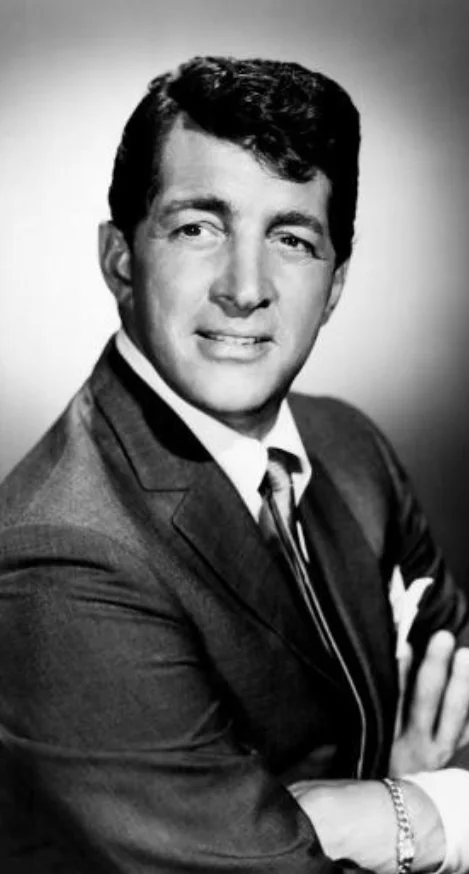
Every Christmas season, a familiar voice returns, carried by a deep voice we all recognize: “Oh, the weather outside is frightful / But the fire is so delightful / Since we’ve no place to go / Let it snow, let it snow, let it snow!” His voice is not only recognizable during the Christmas season, but also whenever we turn to songs that warm our hearts, like “That’s Amore” and “Everybody Loves Somebody.” Beyond his individual talents, he became a cultural legend whose distinctive style influenced generations of performers, including Elvis Presley. Wherever he appeared—on television, on stage, or on screen—he brought an effortless cool, what people today might call aura. For more than four decades, Dean Martin didn’t just perform; he made cool feel natural, earning the title King of Cool.
Dino Paul Crocetti was born on June 7, 1917, in Steubenville, Ohio, as a son of Italian immigrants. He didn’t speak English until he went to school at age five. After dropping out of high school at fifteen, he became a boxer; his tall, muscular build made him a natural fit for the sport. He might have gone on to become a professional boxer, but a broken nose from a match ended that path. After his boxing career ended, he worked at an illegal casino as a roulette stickman and dealer. At the same time, he began singing with local bands under the name Dino Martini, inspired by the Metropolitan Opera tenor Nino Martini. By late 1940, thanks to his remarkable voice, Cleveland bandleader Sammy Watkins invited Dino to sing for him. “That Italian name has to go,” said Watkins—and renamed him ‘Dean Martin.’ Later in September 1943, Martin broke his contract with Sammy Watkins, moved from Cleveland to New York City, and signed an exclusive contract with the MCA talent agency. He was soon booked as a last-minute replacement for Frank Sinatra at New York’s Riobamba Room. This moment marked the beginning of his career as a national superstar.
Soon after his rise to national fame, Martin teamed up with a young, wildly energetic comedian named Jerry Lewis, forming one of the most iconic and influential duos in American entertainment history. Their act leaned heavily on slapstick comedy and broke away from rigid vaudeville traditions. Instead of following strict scripts, they improvised—singing, clowning, and chasing each other across the stage. The contrast between Martin’s smooth, laid-back style and Lewis’s loud, chaotic humor turned out to be perfect. Together, they formed a duo that dominated nightclubs, radio, film, and television in the late 1940s and early 1950s, becoming one of the most successful comedy partnerships in American history. Despite their success, Dean Martin and Jerry Lewis eventually split due to creative differences and their vastly different personalities. Lewis sought more creative control and new projects, while Martin preferred more leisure time for golf and family. Ultimately, they realized they no longer enjoyed working together as much, even though they still cared for each other. This separation allowed Martin to focus on his solo career.
After parting ways with Jerry Lewis, Martin found great success as a solo artist. In 1958, he achieved success as an actor, starring alongside Marlon Brando and Montgomery Clift in The Young Lions. As a singer, he also scored a hit with “Volare,” an English adaptation of Domenico Modugno’s Nel blu, dipinto di blu. Building on his musical success, in 1959, Martin released A Winter Romance, an album that showcased his smooth voice on holiday classics that remain beloved to this day. The album featured timeless Christmas favorites like “Let It Snow! Let It Snow! Let It Snow!”, “Winter Wonderland”, “Baby, It’s Cold Outside”, “Rudolph, the Red-Nosed Reindeer”, and “White Christmas”, introducing Martin’s signature warmth and charm to generations of listeners during the holiday season. These solo successes as both a singer and actor helped Martin solidify his star power and set the stage for the next chapter of his career: joining the Rat Pack.
The Rat Pack was more than just a group of entertainers—it was a cultural phenomenon of the 1960s. The group started with Hollywood actor Humphrey Bogart and his friends, who would gather for poker games and parties. After Bogart’s death, Frank Sinatra became the de facto leader of the Pack. The Rat Pack truly came into its iconic form when Dean Martin joined Sinatra. In 1958, Martin appeared with Frank Sinatra and Shirley MacLaine in Some Came Running. Although they had only been casual friends before the film, Martin and Sinatra grew close during production, even renting a house together and hosting nightly parties that became legendary among Hollywood insiders. Sinatra later brought Sammy Davis Jr., Peter Lawford, and Joey Bishop into the group. On screen, they brought that magic to Ocean’s Eleven, cementing their image as Hollywood icons. After the success of Ocean’s Eleven, the Rat Pack continued to capitalize on their fame, occasionally hosting shows that combined music, comedy, and celebrity-filled parties. These performances kept their legendary status alive and reinforced their image as the ultimate icons of cool. Together, they dominated Las Vegas, turning the city into a playground of music, comedy, and high-rolling glamour, performing sold-out shows that became legendary.
Building on his Rat Pack fame, Dean Martin soon brought his charm and wit to television with The Dean Martin Show, which aired from 1965 to 1974. The variety show combined music, comedy sketches, celebrity guests, and Martin’s trademark relaxed humor, allowing him to showcase both his singing talent and playful personality. He became known for playful antics, like jumping onto the piano—a stunt that once backfired when the production team pranked him with a lightweight piano that collapsed under his weight. Musical moments were just as memorable, including his legendary performance of “One Note Samba” with Caterina Valente. With its blend of spontaneity, humor, and music, the show captivated audiences and solidified Martin’s status as one of America’s most beloved entertainers.
On television, Martin often played the lovable, slightly sloppy drunk, a persona that became one of his trademarks. His relaxed, tipsy demeanor was so convincing that it sparked a lasting question among fans: “Why was Dean Martin always drunk?” Martin himself once joked, “I feel sorry for you people who don’t drink. I mean it because when you wake up in the morning, that’s as good as you’re going to feel all day.” By portraying a relaxed, carefree persona, he enhanced his image of effortless cool.
In reality, Martin’s off-screen life was far more disciplined. He was a devoted family man, the father-in-law of Olivia Hussey, and a consummate professional with a strong work ethic. His real-life discipline, dedication to his craft, and personal warmth stood in contrast to the tipsy, easygoing character he performed for audiences, showing that his “cool” was as much calculated skill as it was charm.
Dean Martin’s influence has endured long past his heyday, with his music continuing to appear in Christmas playlists, films, and pop culture references. Notably, the King of Rock ‘n’ Roll, Elvis Presley, emulated Dean Martin in both singing style and stage presence. Martin’s swagger and relaxed, effortless delivery had a clear impact on the “sexy, wobbly, almost hiccupping baritone” that became Elvis Presley’s trademark. In his early career, Presley often modeled his song arrangements on Martin’s phrasing and style. With nearly an 18-year age difference between them, Presley’s admiration for Martin was unmistakable. In January 1970, while performing at the International Hotel in Las Vegas, Presley spotted Martin in the audience and honored him by singing his hit “Everybody Loves Somebody.” This was far from the first acknowledgment of his respect—Martin’s daughter, Deana, remembered Elvis saying, “They call me ‘The King of Rock and Roll,’ but your dad is ‘The King of Cool.’”
Recently, as expected, his iconic Christmas classic “Let It Snow! Let It Snow! Let It Snow!” joined the billion-stream club on Spotify, proving that even 30 years after his passing, Martin’s voice and charm continue to captivate new generations of listeners. Through his timeless music, unforgettable performances, and signature effortless style, Dean Martin’s warmth, charisma, and cool demeanor ensure that he will always be remembered as the King of Cool.