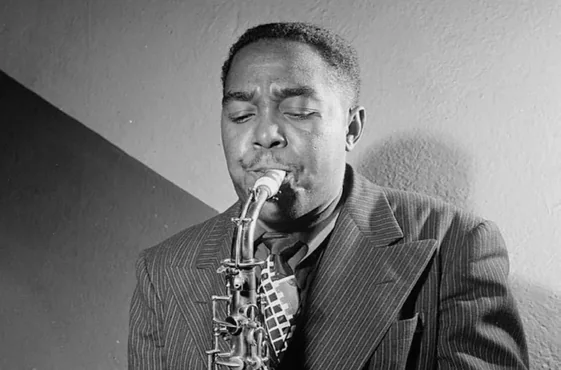
If you have seen the movie “Whiplash,” you already know the story that made Charlie Parker a legend. A teenage saxophone player, still learning, fumbles a solo at a Kansas City Club. The drummer, Jo Jones, throws a cymbal at young Parker’s feet. After that incident, Parker goes home, locks himself in a room, and practices until nobody can laugh at him again. Whether every detail happened as told, the lesson is clear: a boy was laughed off a stage, and he came back as the man every saxophonist has since tried to be.
Charlie Parker Jr. was born in 1920 in Kansas City, Kansas, and grew up across the river in Missouri, where the city’s nightclubs played all night. He took up the saxophone as a boy and left school young. At sixteen, he was injured in a car accident and was given morphine for the pain. He became addicted, and the habit followed him for the rest of his life. He joined Jay McShann’s band in 1940 and moved to New York, where he and the legendary trumpeter Dizzy Gillespie spent nights at Harlem clubs trying out a new way of playing. The swing bands of the day were large and played arranged music for dancers. The new music was played by small groups for listeners, at fast tempos, with each soloist improvising on a song’s chord changes rather than its melody. Parker and Gillespie used richer, more dissonant chords than swing allowed, and their lines moved at speeds that left many players behind. By 1945, they had recorded it, and the music was called bebop.
His career was brilliant, and his life was not. Heroin made him unreliable, and promoters learned to fear his late arrivals. In 1946, he suffered a breakdown after a recording session in Los Angeles and spent about six months in Camarillo State Hospital. New York later took away his cabaret card, the license a musician needed to work in its clubs, which kept him off many of the stages where he was most admired. In 1954, his young daughter Pree died of pneumonia, and his decline sped up.
Parker died on March 12, 1955, in the New York apartment of his friend and patron Baroness Pannonica de Koenigswarter. He was 34. The doctor who examined him guessed his age at somewhere between fifty and sixty, for years of heroin addiction and heavy drinking had worn his body down.
One may ask what makes him so great. Parker’s first gift was speed. He played fast tempos cleanly, with ideas arriving faster than most listeners could follow. What set him apart was harmony. Swing-era soloists mostly kept to the notes of the underlying chord. Parker reached for the higher notes of each chord, the ninths and elevenths and thirteenths, and used them as the center of his melodies. He heard the chords differently from his peers, and what he played over them sounded like a language no one else had yet learned. He also kept a deep feeling for the blues. However complicated his lines became, a listener could still hear Kansas City in them.
This is why bebop was revolutionary. Swing in the 1930s was music for ballrooms, played by big bands, with the dancer in mind. Bebop was played by small groups at tempos too quick for dancing, and it asked the audience to stop and pay attention. The soloist was no longer an entertainer. He was an artist, and the music was a form of speech.
If you ask where to start, begin with Ko-Ko (1945). Recorded in November of that year with Miles Davis in the group, it takes the chords of the standard “Cherokee” and runs a solo across them at a pace that stunned musicians then and still does now.
Donna Lee (1947) comes with an argument. The tune was credited to Parker, but Miles Davis later claimed he wrote it, and the dispute has never been settled to everyone’s satisfaction. Either way, it is a melody built on the chords of “Back Home Again in Indiana,” and it is famously hard to play.
Ornithology and Confirmation, both from 1946, show Parker as a composer. The first is built on “How High the Moon,” and the second is one of the most played tunes in the Jazz repertoire.
Charlie Parker with Strings (1950) surprised the Jazz world. Parker wanted for years to play with an orchestra, and the album, which paired him with a string section, is commonly described as his best seller in his lifetime. Some bebop purists disliked it, but I love it, and Parker did not care. The playing is gorgeous, featuring some of his most famous pieces, such as Summertime, April in Spring, and Just Friends.
His life carried a second meaning. Parker was a Black genius in a segregated nation that was happy to hear him but slow to respect him. He was celebrated and policed in the same year, praised in the clubs and denied the right to play in them. He was asking to be taken seriously, and the country took her time answering.
Most people know the name Charlie Parker. Fewer have sat down and listened to him, which is a loss, because he is among the finest improvisers any music has produced. Put on Ko-Ko and listen for four things. First, the speed: the tempo is close to 300 beats per minute, and every note in his solo still lands cleanly. Second, the harmony: he keeps landing on the upper notes of each chord, the ones other players avoided, and they sound right every time. Third, the rhythm: his phrases begin and end in unexpected places, so the line seems to float above the beat while never losing it. Fourth, the quotations: he often slipped fragments of other melodies into a solo, so listen for a tune you half recognize flickering past.
Then try Parker’s Mood, a slow blues from 1948, and hear how much feeling he could put into a dozen bars at a walking pace. A man who played that fast and that tenderly was not an entertainer who happened to be clever. He died with much of the world still unaware of him. Listen to him now, and make up for lost time.