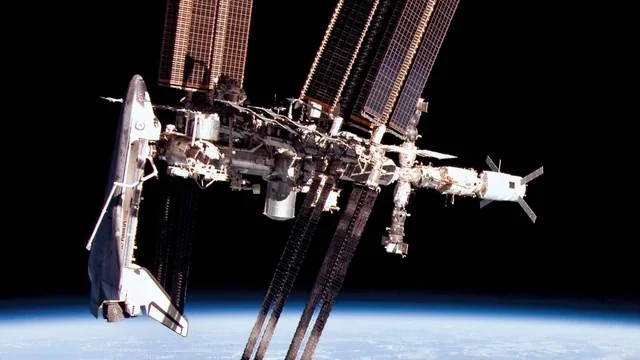
Humanity’s most expensive object, worth over 150 billion dollars, is set to crash into the ocean by 2031. The ISS has been home to over 200 astronauts from over 19 countries and has orbited 227 nautical miles above Earth.
In 1984, the ISS was given official approval by President Reagan. NASA administrator James Beggs set out to find different countries who were willing to cooperate with the program. Canada, Japan, and much of Europe began to participate in the program. The ISS was designed between 1984 and 1993, while the elements of the station were in construction starting in the late 1980s, according to NASA. The ISS went through a redesign in 1993, in which Russia was invited to participate in the program.
All the agencies were unified in their goals for the ISS: research in human physiology, radiation, materials science, engineering, biology, fluid physics, technology, and also enabling future space exploration missions. As of right now, the Alpha Magnetic Spectrometer mounted on the ISS has measured over 100 billion cosmic particles, which have helped scientists search for evidence of dark matter and antimatter. The ISS has also helped to provide insights on protein crystal growth. It was found that growing protein crystals in microgravity yields larger and higher quality structures than on Earth. This has given scientists major progress against conditions like Duchenne’s Muscular Dystrophy. Scientists also created Bose-Einstein condensates, the 5th state of matter, using the Cold Atom Lab on the ISS.
The ISS, like most things, wasn’t meant to last forever. NASA plans to end the ISS’s historical run by crashing it in the middle of the ocean. More specifically, Point Nemo. The ISS is being retired due to aging infrastructure, high maintenance costs, and a shift to the private sector. First, the ISS was launched in 1998, meaning its hardware and systems have been wearing out for almost 30 years. Secondly, maintaining the ISS is very expensive. NASA wants to instead divert those funds into deep-space exploration, Moon, and Mars missions. Finally, privately operated space stations will soon replace the ISS for low orbit research.
You may be asking, why is crashing it the best option? Well, according to journalist Cleo Abram, NASA, along with the other space agencies, had 3 options. The first option was to disassemble the ISS and put it in a museum. It might sound like a great plan, until you realize that it took almost 30 flights to get all the pieces of the ISS in space and over 100 spacewalks to put it together. It would be just as costly, if not more, to do the same in reverse. Also, the only spacecraft that can carry the pieces back down is retired. Option two was to boost it into a higher orbit so it can last longer. The problem is, the vehicles meant to service the ISS cannot reach that high meaning we can’t have any crew on board. Boosting to higher orbit also makes it more vulnerable to being hit by orbiting space debris. The final option was to perform a controlled crash into the Pacific Ocean. The plan is to let gravity take the ISS down a little bit and then have another spacecraft, built by SpaceX, guide it into a controlled crash into Point Nemo, the farthest point from any piece of landmass.
The ISS has been one of humanity’s greatest successes when it comes to science and tech. It has brought together several countries from around the world and has hosted almost 300 astronauts. On top of that, it has contributed to over 4,000 science experiments and has led to amazing breakthroughs in STEM. However, as the ISS ages, it is becoming increasingly harder to maintain the costs and infrastructure. Rather than performing expensive and risky actions to retire it, NASA along with other agencies, has decided to partake in a controlled crash into the South Pacific Ocean. Although it is sad to see the ISS come to an end, the ISS has accomplished more than expected and has paved the way for future innovation and exploration. It will not simply be the end of the ISS – it will mark the beginning of a new era in space exploration.