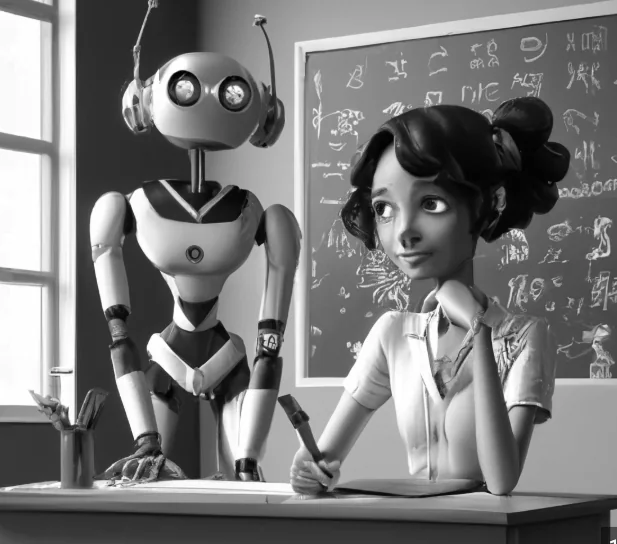
With many calling AI the next “big thing”, comparing it to when the internet first began to revolutionize how we live our lives, education has focused on how AI may affect students but teachers have also been using AI on the other side of the desk. As AI becomes more prevalent in our daily lives, it’s important to acknowledge how it intertwines with our work and appears in our school day.
National trends point to teachers saving an average of 5.9 hours per week when using AI, mostly for streamlining tedious tasks, which could lead to more time for teacher-student interaction. Many teachers caution that with AI the focus must always be on learning, and suggest that an over-reliance on the tool in hopes of getting things like grading done faster would be a mistake.
Within the ABRHS building, teachers’ opinions on AI and integration methods into student learning differ dramatically. Especially with the integration of the AI task force in our school, AI is becoming a prevalent issue within our school. Of the educational departments, science may be the one most in favor of the tool. One teacher reports utilizing Gemini to differentiate assignments for multilingual learners, translating instructions into more accessible language. Another developed a specialized study assistant that generates practice questions that scale in difficulty based on a student’s performance. It’s agreed that AI can be beneficial in learning but at the same time students must stay wary of misinformation; however, this is indeed an issue that will only become less and less of a problem as AI gets more advanced. Furthermore, a teacher noted that AI can do “pretty amazing things in seconds,” but at the end of the day, the student still has to go through the productive struggle of learning.
Similarly in history classes, AI is being used to modify online readings to meet students’ accommodations. Some history teachers have dabbled with AI, letting students use it for evidence generation in the earliest stage of essay writing with a teacher-created prompt. If Gemini were to be open next year to students, some World History teachers would start to incorporate appropriate AI use as a tool, not a replacement.
Many would be surprised to learn that in English, the subject that might be most vulnerable to student AI usage, teachers are more pro-AI than expected. One teacher points out that there is much more to English than just the final product, but it is the process and work that are pivotal. Another teacher adds on to this premise, noting that English may need to transform into a class more focused on the process where AI may be involved than just the final result. While English might be the most vulnerable subject to unwanted AI usage, English teachers argue that AI might be able to assist you in reading, but it could never replace actually immersing oneself in the story.
However, not every teacher shares the rosy view of the usefulness of AI. Many are scared of students using AI to plagiarize their writing and put it off as their own. In fact, they even use software and AI detectors to ensure that students do not do this. In math classes, teachers highlight the troubles of working with the tool, finding more inefficiency in it than benefit. To create a work sheet, constant editing is created a product that is semi-useful, but even after that, a teacher comments how answer keys could still be “complete garbage.” Overall, in the math department teachers reveal that it’s much more efficient to create a worksheet themselves than going through the constant instruction, refining, and edits involved in implementing AI.
As the AI Task Force works to bridge the gap between classroom experimentation and formal policy, ABRHS stands at a pivotal crossroads. The “productive struggle” of learning remains a fundamental value for the district, even as the methods of that struggle undergo a digital transformation. Whether it is a science teacher differentiating a lesson or an English teacher rethinking the weight of a first draft, the focus is increasingly moving away from the final product and toward the human process behind it. In a world where AI can generate complex content in seconds, the challenge for ABRHS will be ensuring that, as these new tools become commonplace, they serve to enhance student thinking rather than replace it. Say no to AI slop!