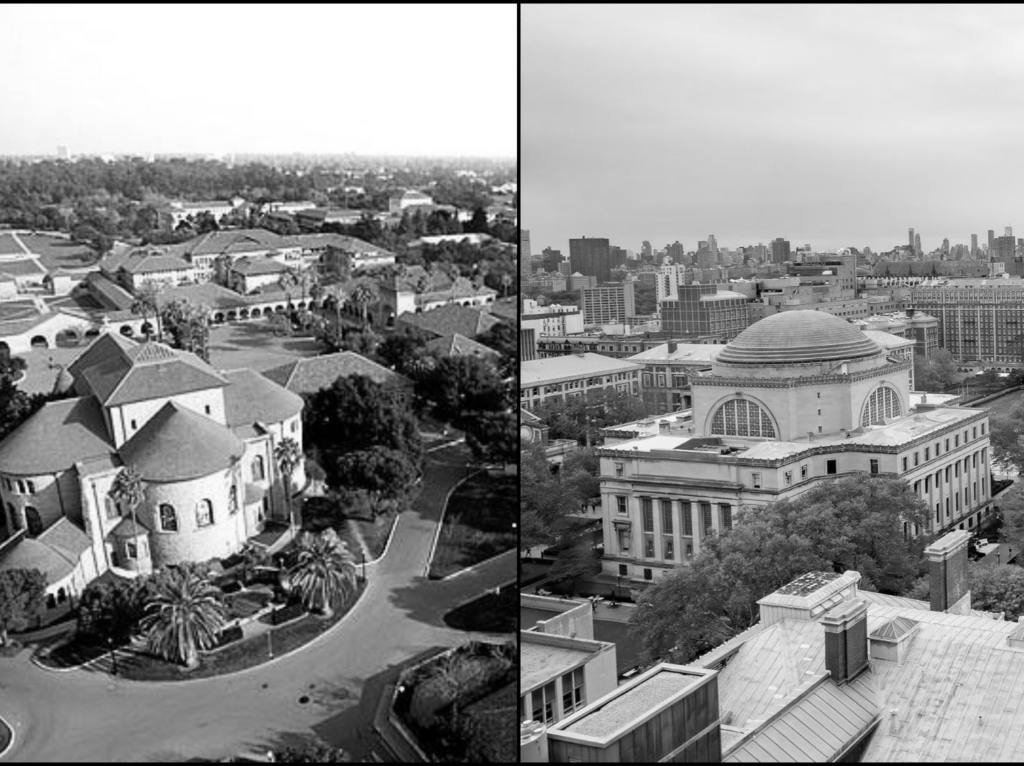
City and rural campuses are polar opposites in higher education, rivaling each other in terms of resources, student bodies, and prestige. Some high schoolers prefer to attend urban schools like New York University (NYU) for its bustling environment and access to entertainment instead of secluded schools like Dartmouth College where nature is the great attractor, or vice versa. Given the polarizing nature of this choice, the question is this: how have these two environments remained so competitive, and why is picking the wrong one detrimental to the person’s experience at the school? Before the 20th century, America’s higher education culture started in rural colleges. A typical college experience included a balance of studying, campus events, and free time in green spaces. The act of learning was more focused on the tight-knit academic community than the outside world. However, urban universities flipped those traditional qualities on their head with their introduction of city campuses. Urban schools, such as Boston University or NYU, began as academic institutions completely combined with their surrounding metropolitan streets, pioneering the “city as your campus” lifestyle that some students love. City campuses mainly began getting massive attention when students realized the sheer volume of networking opportunities they provided. Originally, a student’s focus usually involved clubs and local Greek life. However, over time the city campus experience became more extreme, with students juggling off-campus city internships while having a full schedule. In addition, the cost of living was the most notable change, going from a small room and board fee to upwards of thousands of dollars for a cramped living space. People thought city students were thriving, but what they presented to social media were only the highlights. In reality, the urban university culture exposed many young adults to overwhelming burnout. We all know a person, whether it is a friend or a sibling, who gets burnt out from the high stress environment of school or their jobs, or a combination of both. Many began adopting unhealthy working and sleeping habits to sustain their high living expenses, all the while universities continued to make a profit, leaving students with immense debt and chronic stress. But how do isolated, rural campuses such as Dartmouth College or Kenyon College affect the social and professional lives of their students? Though the effects are not always immediately clear, college students end up relying heavily on the university to provide for their social and professional needs due to the town’s small scale. Students at isolated rural campuses were found to be significantly more likely to experience cabin fever and seasonal depression (NIH). Some may claim that a rural campus’ superior natural beauty and tight-knit community are worth the closure from the outside world. However, living in a small college town means that local businesses, much like Santa Fe and the gas stations around AB that see business after classes end, survive mostly on the student body. In essence, the university forces the student into a small social bubble that lacks the diverse food and cultural offerings of an urban center. Adding on to potential mental health risks, research shows that there is a direct correlation between consistently living in an isolated campus environment and increased reliance on exclusive social groups, like fraternities and sororities (Springer). Even if people do not participate in Greek life themselves, rural campuses also tend to have limited off campus options, which can lead to social exclusion. Aside from social harm, attending a rural campus can also be professionally detrimental for students. As city students gain easy access to school year internships, rural students are compelled to cram all of their professional development into the short summer months in order to gain employers’ attention. This leads to an increase in stress and pressure for rural students. So, how does this relate to high school seniors applying to college, and what are the implications? Well, based on the academic and social effects of both environments, it is clear that many prospective students could be negatively affected if they choose blindly. People who thrived by being focused in high school could start failing at an urban school if they find the distractions and expenses too overwhelming. Also, ambitious students who crave diverse experiences could lose their drive at a rural school. In this way, both city and rural campuses can create unique forms of stress on unprepared students. In conclusion, both rural and city campuses may be a welcome addition to a student’s life depending on their personality. But because of city schools’ higher living expenses and pressure on mental health, or rural schools limiting off-campus professional and cultural opportunities, choosing an environment without deep consideration of one’s goals for college may lead to a more difficult path. However, you know yourself better than anyone else, so whatever you choose will be the best possible decision for you.
City vs. Rural Campus